
Common Loon, May 2026 (KFGO News Photo, Nate Coen)
ST. PAUL, Minn. (KFGO/WCCO) – Minnesota’s loons, the iconic state bird, are facing growing threats.
It’s not hyperbole, it’s something the Minnesota Department of Natural Resources has been tracking for years. While Minnesota’s adult loon population remains steady, at around 12,000 birds overall, state wildlife officials are tracking a concerning long term decline in juvenile survival rates.
To combat this, the DNR’s Minnesota Loon Monitoring Program is surveying hundreds of lakes. Tim Mitchell, Loon Program Coordinator with the Minnesota Department of Natural Resources, says the goal is to collect critical data on things like nesting success.
“Juvenile loons, we think, is declining by about 0.6% per year over the course of our 32-year study, but it’s definitely something that we’re concerned about,” Mitchell says. “It’s not just happening in Minnesota. We’ve seen reports out of Canada and Wisconsin.”
While 0.6% might seem like a low number, a trend that is over three-decades old means the population can’t sustain itself. Minnesota has more loons than any other state except Alaska.
“Every animal population, if you study it long enough, goes up and down through time. Like, no populations are stable, but it’s definitely something that we’re concerned about,” he said.
DNR says its estimates about declining chick populations can take a long time to show up in the adults. Loons can live 20-30 years.
“It’s a really long-lived bird,” Mitchell says. “So, if reproduction sort of falls out from underneath, it can take a long time for us to see that in the adult population.”
Mitchell says the DNR has deployed a multi-layered conservation effort tracking bird counts across 600 lakes. He says the program combines field monitoring and community education.
“It started in 1994,” Mitchell says. “Each year annually, we survey 600 lakes, 100 in each of six different index areas. These are mostly done by volunteers in the state. They go out and they look for adult loons and juvenile loons and count them and report that back.”
Not every area of the state is seeing the same issues. The project is focused in eight northern counties: Becker, Clearwater, Beltrami, Hubbard, Cass, Crow Wing, Itasca and Aitkin.
However, Mitchell says they have seen reductions in the number of juveniles per pair of loons in Cook County and Itasca County, with some lesser amounts in Otter Tail County as well. But in other counties, populations seem more stable. Those include areas around Aiken, Crow Wing and Kandiyohi counties.
Mitchell adds they are doing what they can to educate Minnesotan’s about how to take care of their lake homes, and provide a safe space for loons.
“Talking about how to be conscientious of the birds and how folks who live on lakes can treat their shorelines in a way to try to restore natural vegetation,” he said. “As well as how to be conscientious of recreation on the lakes.”
The goal is to try to keep loons out of harms way. Much of that comes from humans doing what humans do on the state’s greatest resource, lakes.
“If you’re fishing, consider using non-toxic tackle,” Mitchell suggests. “When you’re boating, keep an eye out for the loons. Don’t assume they can dive out of your way. Especially, loons with chicks are vulnerable. So slow down.”
While the numbers of chicks drop, Mitchell says they believe many factors need to be considered, but adds they don’t have a smoking gun for this issue.
“There’s a lot of changes going on in the state,” Mitchell explains. “There’s water quality changes, water clarity changes, increased development, the climate is changing. And so, all of these things could be contributing factors as well as shoreline development, things like that, that can reduce nesting success. So, there’s a lot of different things going on over this time period, and we’re not sure exactly what’s going on.”
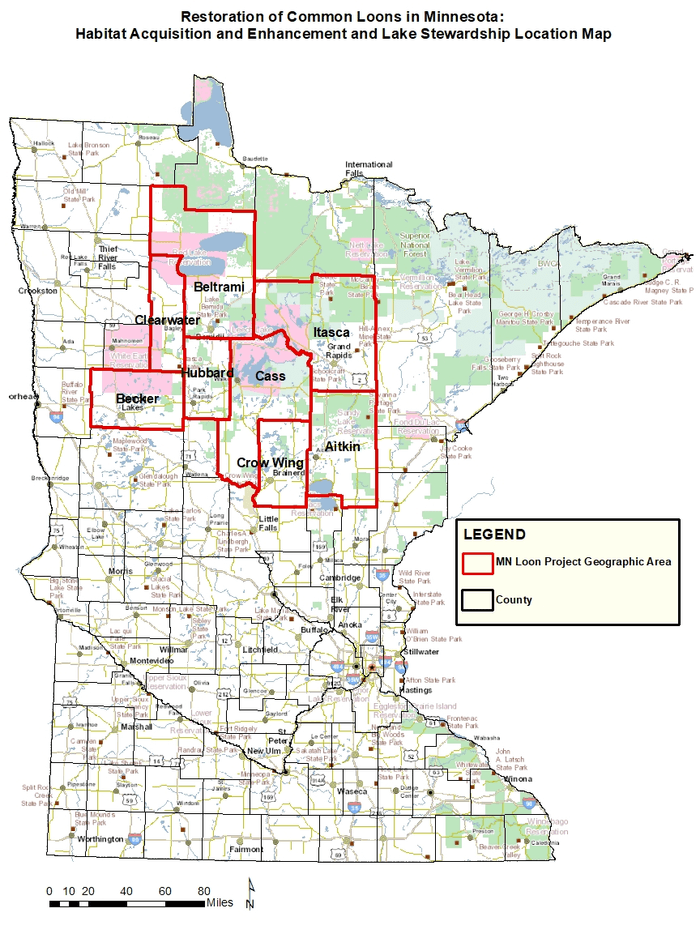
The Minnesota Loon Project area in red.
(Minnesota Department of Natural Resources)
Artificial Nesting Platforms for loons
Artificial Nesting Platforms (ANPs) are floating platforms that can be used under certain conditions to support loon nesting. The Minnesota Loon Restoration Project uses ANPs to augment natural nesting locations in targeted locations.
“It’s like a birdhouse for loons as a conservation tool,” explains Mitchell. “We have a study going on with that right now, which may improve nesting success. But then we’ve also got chicks that hatch out, and they’ve got to stay healthy and grow all summer before they can migrate out of here in the fall.”
There is no guarantee these artificial platforms will work, however. The DNR says conditions for these platforms are very specific, such as when loons have had consistent nesting failures (2 to 3 times over the past 5 years), where water levels fluctuate during the nesting season, and if predation is significant or reoccurring.
“Well, when we consistently know a pair of loons is failing to produce chicks naturally, failing to hatch eggs naturally, we sometimes suggest a nesting platform might help if they’re doing it OK, naturally,” Mitchell adds. “We usually don’t think there’s a reason for a nesting platform. So that’s one element of it.”
Mitchell says the important part comes when they leave the nest – or platform.
“But once they hatch out, once the chicks are on the water, the platforms don’t do much because they’re pretty much completely aquatic,” he says. “And so at that part of the life stage, the platforms aren’t doing a whole lot.”
At that point, Mitchell says water clarity, water temperatures, and other habitat issues become important.
“So, if you have lakeshore, you live in a watershed, there’s not fertilizing your lawns, trying to leave natural shoreline in the water and on the shore,” Mitchell explains. “That can take up a lot of nutrients that would otherwise get in the lake, and potentially cause water clarity and water quality declines.”
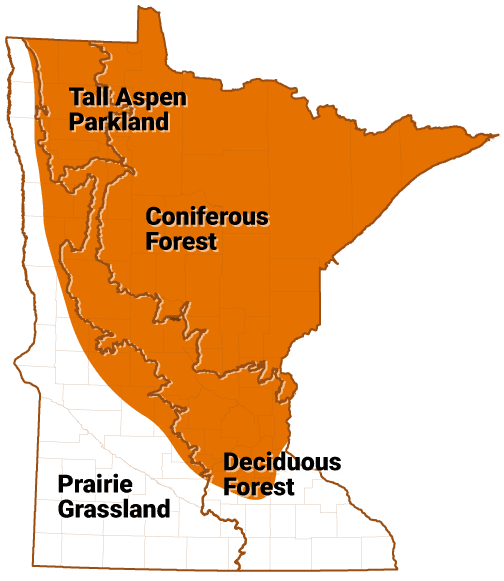
Common loon range across Minnesota.
(Minnesota Department of Natural Resources)
Funding for conservation will be crucial
Mitchell says crucial future work to protect the state bird will depend on the agency’s ability to secure new state and federal funding as a major federal restoration grant expires this year. The Minnesota Loon Restoration Project was heavily funded by something that happened a long way from Minnesota, the Deepwater Horizon oil spill settlement.
In September, Minnesota’s adult loons travel to their winter home along the Atlantic coast from North Carolina south to Florida, or on the Gulf of Mexico. Younger loons follow a month or so later. When the Deepwater Horizon exploded in April 2010, hundreds of wildlife species were impacted, including Minnesota’s common loons.
The Nongame Wildlife Program created the Minnesota Loon Restoration Project to help this beloved species.
“That portion of the project is just winding down now,” says Mitchell. “We did some habitat acquisitions, we did that artificial nesting platform study under that. We’ve done a lot of outreach with lake associations, but we’re in our final year of that.”
This $7.52 million dollar project was implemented by the Department of the Interior, United States Fish and Wildlife Service, in partnership with the State of Minnesota. Now, they’ll need other funding sources.
Fees to the program from the Minnesota United’s loon license plates are helping fill the gap, for now.
“So, individuals that buy those license plates, there’s an extra fee, and that comes to the Loon Restoration Program at the Minnesota DNR,” says Mitchell. “And then we’re also continuing to seek other sources of funding to expand our reach and ability to work on loon conservation in the state.”







Comments