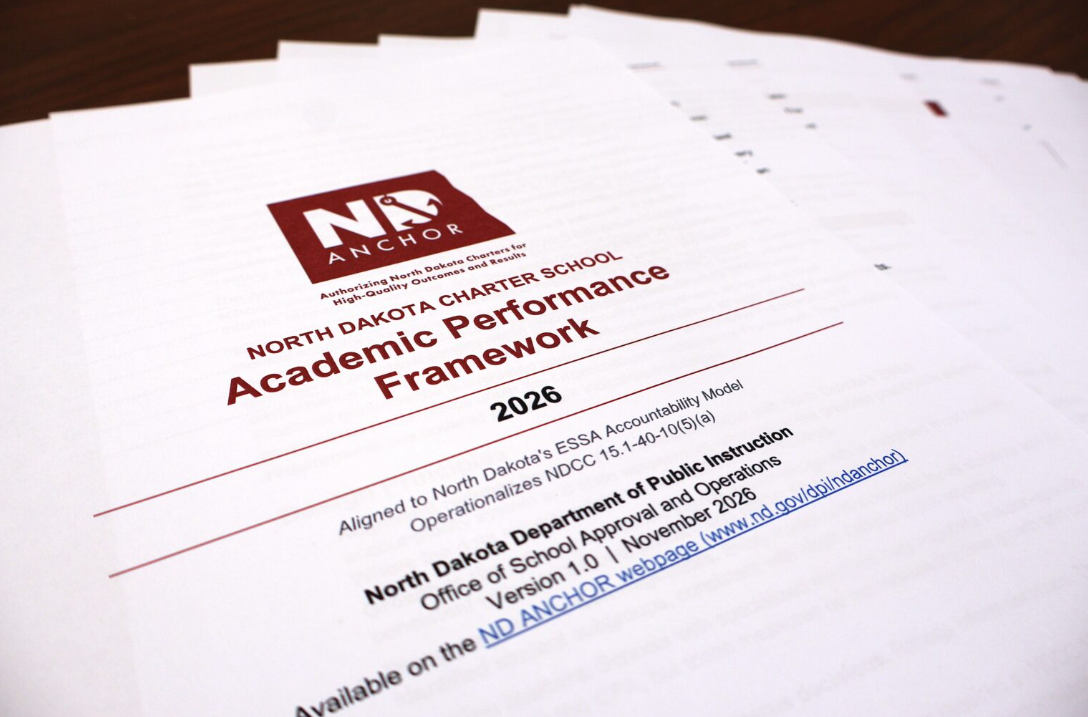
A North Dakota charter school academic performance framework packet is displayed on Nov. 11, 2026. North Dakota Monitor Photo.
BISMARCK, N.D. (North Dakota Monitor) – North Dakota’s first charter schools are potentially on the horizon for fall 2027 as the Department of Public Instruction released application materials last week and a timeline to set the new schools in motion.
North Dakota public charter schools were authorized by the Legislature in 2025 with the passage of Senate Bill 2241.
“Opening a public school is a serious responsibility, and North Dakota families deserve confidence that any new school has a clear plan to help students succeed,” said Superintendent of Public Instruction Levi Bachmeier in a statement.
The state will provide an average per student payment of about $8,300 to each charter school based on its enrollment. The new schools are not eligible to receive funding from property taxes, according to the department.
Applications for new charter schools under the ND ANCHOR program, Authorizing North Dakota Charters for High-Quality Outcomes and Results, can be submitted to the department beginning Dec. 2 and will continue until March 2, 2027, according to the DPI website.
Under state law, public charter schools will operate within the state’s public education system and cannot charge students tuition. They also must enroll all students who apply and use a lottery system, if enrollment surpasses the school’s capacity. Public charter schools must not base admission criteria on ethnicity, national origin, religion, gender, income level, English proficiency or disabling conditions.
The schools are also prohibited from engaging in religious educational programming and operations, according to state law.
Arlene Wolf, director of school approval and opportunity for the department, said the application materials, process and timeline were the results of nearly two years of work looking into best practices.
“We’re ensuring that we’re really, truly opening those that are high quality schools with really good plans and have the best interests at heart,” Wolf said. She added the department consulted with national charter school organizations and other states.
A public charter school is not something that can be opened quickly, she said, and potential schools should take some time to weigh whether becoming a public charter school would be the best fit.
Wolf said the performance agreements with the department will be a key mechanism in setting the benchmarks for the new charter schools and evaluating their success.
As part of the application, prospective charter schools must enter into performance agreements that measure student academic proficiency and growth, attendance and recurrent enrollment, graduation readiness, financial and governance performance and community engagement. The school’s results in those areas will determine renewal eligibility and potential corrective action if performance goals are not met, according to the department.
“They are kind of held to that,” Wolf said. “It is a contract.”
Nick Archuleta, president of ND United, a union representing teachers and public employees, said the charter school performance agreements are an important guardrail to ensure quality education.
“If you are covering the academic, financial and governing structures of these things, that’s a very good place to start,” Archuleta said. “I think it is a sustainable path and I think it’s a good path because it does put those guardrails in right away so there isn’t any gray area.”
He also commended the department for requiring licensed teachers and staff members for the charter schools, as well as, an in-person learning requirement that would prevent online academies from sprouting up across the state.
“We know that education is predicated on relationships,” he said. “And it’s hard to form those relationships, if you are going to be constantly online.”
Each potential charter school must also submit to a public interview with department officials before any approval decision is made.
Established North Dakota schools are able to convert to public charter schools under the law.
Private schools that could potentially shift to a public charter school may already have a lot of the information needed for the application, she said.

The department will release an informational video Monday to explain the application process.
“We wanted to get it out. We wanted people to look it over,” Wolf said. “It’s gonna take time.”
Dave Archambault Sr., a member of the Standing Rock Sioux Tribe, a former principal and superintendent of tribal schools in South Dakota, told members of the department during a December administrative rules hearing that charter schools give opportunities for communities to try something new, which is needed in tribal education.
“I want a lot more for our children on these reservation schools to do better,” Archambault said. “It (charter schools) has such great possibilities for developing human potential and that’s what I want.”
He said having more options for Native American families choosing where to send their children to school could lead to more successful outcomes.
During the 2021-22 school year, the average graduation rate for students across the U.S. was 87% while the rate for Native American students was 74% during the same time period, according to the National Center for Education Statistics.
A few people and groups have reached out to the department since the application was posted last week, Wolf said, but interest has waned a little since the law went into effect in 2025.
The department also plans to open another application window for public charter schools next fall, she said, and hopes to have an annual application window opening every fall.






Comments