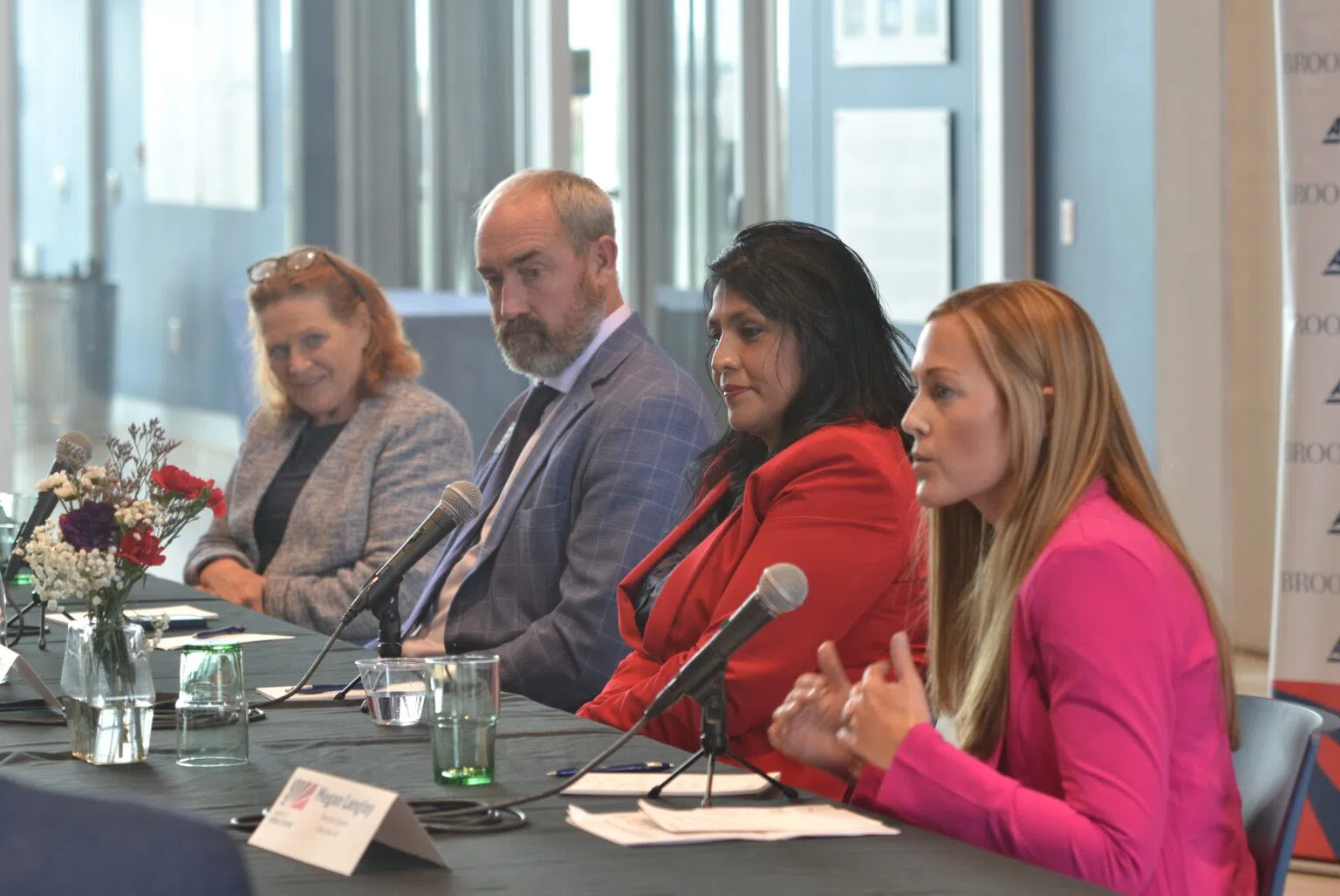
Megan Langley, right, executive director of StrengthenND, speaks Oct. 22, 2025, at Grand Farm near Casselton, North Dakota, as part of a panel examining rural policy. Former U.S. Sen. Heidi Heitkamp, left, led the panel, which also included state Rep. Jared Hagert and Lorraine Davis, president and CEO of the Native American Development Center. (Photo by Jeff Beach/North Dakota Monitor)
By: Jeff Beach
CASSELTON, N.D. (North Dakota Monitor) — Former U.S. Sen. Heidi Heitkamp used her home state of North Dakota on Wednesday for the first of a series of meetings she hopes will help policy affecting rural America.
“There has not been a kind of broad comprehensive look overall at rural policy … since during the Depression,” Heitkamp said in an interview Wednesday after the America’s Rural Future hearing at the Grand Farm research campus near Casselton.
The project is a partnership of the Brookings Institution and the American Enterprise Institute. This project, led by co-chairs Heitkamp, a Democrat, and former New Hampshire Gov. Chris Sununu, a Republican, launched earlier this year.
Heitkamp said rural issues, such as housing and health care, are often treated separately instead of as related challenges. The group plans to make policy recommendations in the fall of 2027.
Wednesday’s meeting had two panels: one on connectivity, highlighting North Dakota’s success in providing statewide high-speed internet access despite being a very rural state, and another on investing in rural communities.
North Dakota’s broadband network is one of the factors that makes it attractive for data center developers and tech companies wanting to provide artificial intelligence.
Mac McLennan, CEO of Minnkota Power Cooperative, said North Dakota has always been an export state, with not enough population to use all the ag, energy and other products it produces, with artificial intelligence a potentially valuable commodity.
“What are people going to use for tools in the future?” McLennan asked. “An AI data center is fundamentally just a manufacturing facility for a tool you just can’t see.”
On investing, Megan Langley, executive director of the nonprofit StrengthenND, said it is great that there are grants and government programs available for rural communities, but small towns often lack the resources to even apply for grants or raise the matching money needed to qualify for programs.
“Everything you need to successfully apply for a federal grant is really, really difficult for a rural community to be able to obtain,” Langley said. “When you think about community readiness, has a needs assessment been done? Has a feasibility study been done? Have architecture and engineering work been done? Likely not. … All that costs money, and a rural community may not have a lot of money.”
Afterward, Heitkamp noted the contrast of the dynamic possibilities for North Dakota highlighted in the first panel and Langley’s concern that some places are being left behind.
“I think that’s going to be the story in a lot of places across the country,” Heitkamp said.
A second hearing is planned for Thursday in Mahnomen, Minnesota.







Comments